One model, many different actions
Overlays mark the input action.
Compositional Action Generalization
Our model allows multiple action controls simultaneously, even though it only sees one action at a time during training.
Comparison with Conditioning Mechanisms
UniAction follows every kind of action more faithfully than visual or token-based conditioning.
Benefits of Unified Training
One model trained on all actions together outperforms experts trained on each action alone.
Temporal Generalization
UniAction starts the motion exactly when the force is applied, even at times it never saw in training.
Scene Generalization
UniAction carries these actions into scenes far beyond its training data.
Abstract
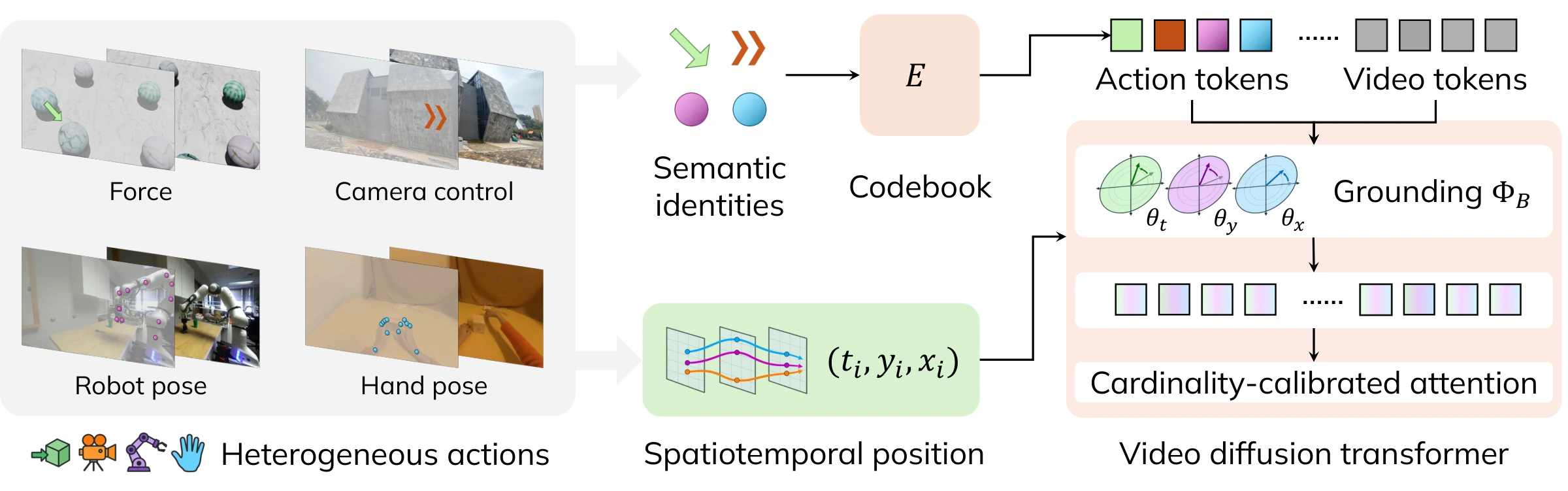
Actions that condition world models are highly heterogeneous, and thus existing action-conditioned world models are typically built for individual action types, fragmenting already limited action-annotated data across separate models. We introduce UniAction, a unified action-conditioning framework that represents any action as a sparse set of action elements, each with a discrete semantic identity and a continuous spatiotemporal grounding coordinate. By mapping these coordinates directly into the pretrained video model’s native positional space, UniAction allows heterogeneous actions to condition a shared world model within the same spatiotemporal structure. We further introduce cardinality-calibrated attention to address the bias from differing action representation granularities. We evaluate UniAction on four representative action forms: force, camera control, hand pose, and robot pose. UniAction outperforms conditioning alternatives in action following, and a single jointly trained model surpasses the action-specific experts, showing that heterogeneous action data benefit from unified model and joint training.
Overview
BibTeX
@article{xue2026uniaction,
  title   = {UniAction: Unified Action Conditioning for World Models},
  author  = {Xue, Bowen and Li, Zizhang and Yu, Hong-Xing and Wu, Jiajun},
  journal = {arXiv preprint arXiv:2610.32977},
  year    = {2026}
}